
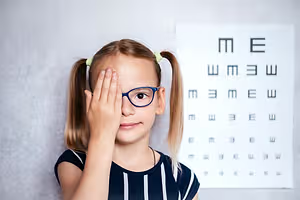
You sit beside your child as they read. Their finger drifts off the line, as if their eyes can’t keep up. A page that should take minutes stretches longer, and focus seems to come and go.
Or maybe everything looks perfectly fine, yet something still feels off. No obvious signs. No complaints. Just a quiet sense that something isn’t quite clicking.
When these subtle worries arise, a comprehensive children’s eye exam in Reno can provide clarity. For a deeper look at how vision develops and how subtle issues can affect learning, explore EyeZone Nevada’s eye conditions page for helpful context.
What Is Amblyopia (Lazy Eye)?
Amblyopia, often called lazy eye, occurs when the brain relies more on one eye than the other.
Over time, the brain relies more on the stronger eye and uses the weaker eye’s signals less and less. This means amblyopia is a brain-eye connection issue, not just an eye problem.
Many people assume lazy eye always involves a visible eye turn. That is one type, called strabismus. However, amblyopia can develop even when the eyes appear perfectly straight and healthy. Amblyopia is a functional vision loss that does not have to be permanent.
What Causes Lazy Eye?
Amblyopia can develop for a few common reasons:
- One eye needs a stronger prescription than the other
- The eyes are not aligned properly, as seen in strabismus
- Vision was blocked early in life, such as from a cataract
In each case, the brain favors the clearer image from one eye. Over time, this weakens vision in the other eye.
Many parents are surprised to learn this, especially when nothing seemed obviously wrong. Amblyopia often develops quietly, without clear outward signs.
Signs of Lazy Eye in Children You Might Miss
Some children can describe what they see. Many cannot. That is why the signs are often subtle.
Signs of lazy eye in children may include:
- Losing place while reading
- Squinting or closing one eye
- Tilting the head frequently
- Poor depth perception
- Avoiding reading or close-up tasks
- Short attention span during visual activities
- Appearing clumsy
- Poor hand-eye coordination
These signs are often tied to how vision develops and how the eyes work together. Sometimes, there are no obvious signs at all, which is why an eye exam plays such an important role.
Does Lazy Eye Affect Learning?
Vision plays a major role in how children learn.
When one eye provides weaker input, the brain works harder to process information. This can result in:
- Slower reading
- Reduced depth perception
- Difficulty with hand-eye coordination
Many families feel a sense of relief once they understand that vision may be part of the problem.
Why Early Care Matters for Vision Development
A child’s visual system develops over time, especially in the early years.
When professionals identify amblyopia early, functional vision loss is not as embedded. Opportunities to support how the eyes and brain work together can occur at any age, but can be gained more easily at a young age. Care strengthens the weaker eye and improves coordination between both eyes.
This process builds over time with consistent, guided care. It takes patience, not a quick fix.
How to Tell if Your Child Has a Lazy Eye
If you’re wondering how to tell if your child has a lazy eye, an exam is the most reliable way to find out.
A comprehensive pediatric eye exam evaluates how the eyes work together, how the brain processes visual input, and whether one eye does more of the work.
Your provider will walk you through the next steps, so you always know what comes next.
How Do We Treat Amblyopia?
Once we identify amblyopia, we build a plan that helps both eyes work together more effectively. Amblyopia treatment focuses on helping the weaker eye take a more active role while improving coordination between both eyes.
Treatment may include:
- Glasses or contact lenses to correct differences in prescription
- Patching the stronger eye for short periods
- Atropine drops as an effective alternative form of occlusion therapy
- Vision therapyto support binocular vision
Vision therapy can play an important role by helping the eyes learn to work together more effectively.
Progress takes time, and we tailor each treatment plan to the individual.
When Should You Treat Lazy Eye?
Parents often ask if they’ve missed the right time to act.
Earlier care allows more flexibility during visual development, but support can still be beneficial at different stages:
- Young children often respond well during early development
- Older children and teens can still make progress with guided care
- Adults may also benefit, especially with modern treatment approaches
When families ask, “Is it too late to treat lazy eye?” the answer depends on the individual, but options are often available.
Can Adults Have Amblyopia?
Amblyopia can continue into adulthood if you never address or fully manage it.
Some adults notice:
- Weak vision in one eye
- Difficulty with depth perception
- Eye strain during daily tasks
An evaluation can help identify the cause and outline options for improving visual function and comfort.
Does Lazy Eye Go Away on Its Own?
Amblyopia does not typically resolve on its own.
Because the brain adapts to favor one eye, that pattern usually continues without guidance. Treatment helps shift that pattern and support more balanced vision.
When to Schedule an Eye Exam for Lazy Eye
If something feels off or you notice signs of lazy eye in your child, an exam is a practical place to start. Patching is just one technique to improve lazy eye. To fully treat amblyopia, vision therapy is more effective.
At EyeZone Nevada in Reno, NV, care focuses on understanding how your child’s eyes work together and guiding you through each step with clarity.
Request an appointment to get clear, thoughtful answers about how your child’s eyes work together.